The highest-impact local SEO actions for a small business are claiming and optimizing your Google Business Profile, fixing NAP consistency across the web, and building a steady review habit. These three moves produce the fastest, most measurable gains in local visibility, and they cost time, not money, so you can start today.
TL;DR:
- Claiming and verifying your Google Business Profile should be your first priority, as nothing improves rankings until this is completed.
- Maintaining a steady review flow and responding promptly to all reviews have more ranking impact than simply accumulating a large number of reviews.
- Fixing NAP inconsistencies across directories and building relevant citations can significantly enhance local visibility over time.
- Creating and optimizing location-specific pages and adding local schema markup support your GBP and organic rankings effectively.
- Proper technical website setup, including fast hosting, schema implementation, and mobile usability, is essential for sustained local SEO success.
Table of Contents
- What Is the Fastest Local SEO Checklist for Small Businesses?
- Google Business Profile: How to Claim and Optimize Every Field That Matters
- What On-Site SEO Tasks Actually Move Local Rankings?
- How Do You Fix NAP Inconsistencies and Build Citations?
- How Many Google Reviews Do You Need, and How Fast?
- What Local Content Actually Attracts Nearby Customers?
- Where Can Small Businesses Find Local Backlinks?
- How Do You Track Local SEO Progress Correctly?
- How Does a Web Studio Handle the Technical Side of Local SEO?
- What Should You Prioritize First for the Fastest Results?
- When Does It Make Sense to Bring in Nordicweb?
- Sources
What Is the Fastest Local SEO Checklist for Small Businesses?
Local SEO for small business owners doesn't need to be complicated. It needs to be sequenced correctly. Google's own guidance says local ranking comes down to three factors: relevance, distance, and prominence, and it specifically recommends verifying and completing your Business Profile as the fastest way to move up. That single recommendation is the backbone of everything below.
Here's the order that produces results without wasting your week.
- Claim and verify your Google Business Profile (GBP). Why first: nothing else works until this is done. Time: 20 minutes to claim, 1–5 days to verify. Do it yourself.
- Set your primary category with precision. Why: category accuracy is one of the fastest levers for Map Pack movement. Time: 15 minutes. Do it yourself.
- Audit and fix NAP consistency. Why: mismatched name, address, or phone number across directories confuses Google's confidence in your listing. Time: 2–3 hours. DIY for small businesses, tool assisted for anything with multiple locations.
- Launch a review request routine. Why: review velocity now outweighs raw review count in many ranking models, according to BrightLocal's research. Time: 30 minutes to set up scripts, then 10 minutes a week. Do it yourself.
- Build one strong location page per site (or per service area). Why: this supports both GBP relevance and organic rankings. Time: 3–4 hours. Hire a writer or developer if your website skills are thin.
- Add LocalBusiness schema markup. Why: it clarifies your business data for search engines. Time: 1–2 hours if you know basic HTML, otherwise hire a developer.
- Set up rank tracking and Search Console. Why: you can't manage what you don't measure. Time: 1 hour setup, 15 minutes weekly review.
For your first 30 days: tackle tasks 1 through 4 in week one, task 5 in week two, and tasks 6 and 7 by week four. That gives your profile and reviews time to build momentum while the technical work catches up.
Google Business Profile: How to Claim and Optimize Every Field That Matters
Your GBP is the single most influential asset in local SEO, and most small business owners leave half of it blank. Verification comes first: Google typically offers phone, email, or postcard verification, and an unverified profile rarely shows up in the Map Pack at all. Skip this step and nothing else here matters.
Your primary category deserves more thought than most owners give it. "Restaurant" is vague. "Italian Restaurant" is specific, and specificity tends to correlate with faster ranking improvement, according to practitioner data on local ranking factors. Choose the narrowest category that accurately describes your core business, then add secondary categories for real services you offer.
From there, fill in every field GBP gives you:
- Write a business description that names your services and your service area in plain language, not marketing copy.
- Upload at least 10 photos, updated seasonally, showing your storefront, team, and completed work.
- List every service you actually offer, with brief descriptions.
- Use the Posts feature weekly to share updates, offers, or events.
- Answer the Q&A section proactively before customers ask.
Pro Tip: Set a recurring 15 minute calendar reminder every Monday to post one GBP update. Profiles that stay active tend to earn more trust signals than ones that go quiet for months.
Review signals round out the profile. Volume matters, but velocity (steady reviews over time) matters more than a one time burst. Respond promptly to every review, positive or negative. Google explicitly ties completeness and prominence together in its own local ranking guidance, so an incomplete profile is working against you before you've done anything else.
What On-Site SEO Tasks Actually Move Local Rankings?
Your website supports your GBP, not the other way around, but it still carries real weight. Start with keywords: your city or neighborhood name belongs in your title tag, your H1, your meta description, and naturally within your first paragraph of body copy. Don't stuff it. One mention per key section reads naturally; five reads like spam.
If you serve multiple areas, build a dedicated location page for each one. A good location page includes:
- A unique introduction naming that specific neighborhood or city, not a copy-pasted template.
- Local landmarks, cross streets, or service area boundaries.
- Customer testimonials from that specific area if you have them.
- Your NAP displayed as visible text, not just an image.
- A clear call to action and contact form.
Add LocalBusiness JSON-LD schema to your homepage and every location page. This structured data gives search engines your business name, address, phone number, hours, and category in a machine-readable format, and it's one of the technical implementations that reliably support local visibility. If any page answers common customer questions, add FAQPage schema too. It's a common source of rich snippet eligibility.
Finally, check the basics: run your site through Google Search Console, confirm mobile usability shows no errors, and test your page speed. A slow, broken mobile experience undermines every other local SEO effort you make, because Google factors user experience into how it ranks your pages.
How Do You Fix NAP Inconsistencies and Build Citations?
NAP stands for name, address, and phone number, and inconsistency here is more common than most owners realize. A former suite number, an old area code, or a shortened business name on one directory can quietly work against your rankings everywhere else.
Start with an audit. Search your business name plus your city across Google, Bing, Yelp, Facebook, and any industry-specific directories relevant to your trade. Write down every version of your NAP you find. Common sources of errors include old directory listings from a previous address, data aggregators that scraped outdated information years ago, and inconsistent formatting (Street vs. St., Suite vs. Ste.).
Once you've mapped the discrepancies, prioritize fixes in this order:
- Google Business Profile and Bing Places first, since they carry the most search visibility.
- Major data aggregators next, since they feed dozens of smaller directories automatically.
- Industry-specific directories relevant to your trade (contractors, medical, legal, hospitality, etc.).
- General directories like Yelp, Facebook, and Apple Maps.
BrightLocal's local SEO checklist treats citation consistency as a foundational task, right alongside GBP completeness. Once your citations are clean, set a quarterly calendar reminder to recheck them. Businesses move, phone numbers change, and old listings resurface more often than you'd expect.
How Many Google Reviews Do You Need, and How Fast?
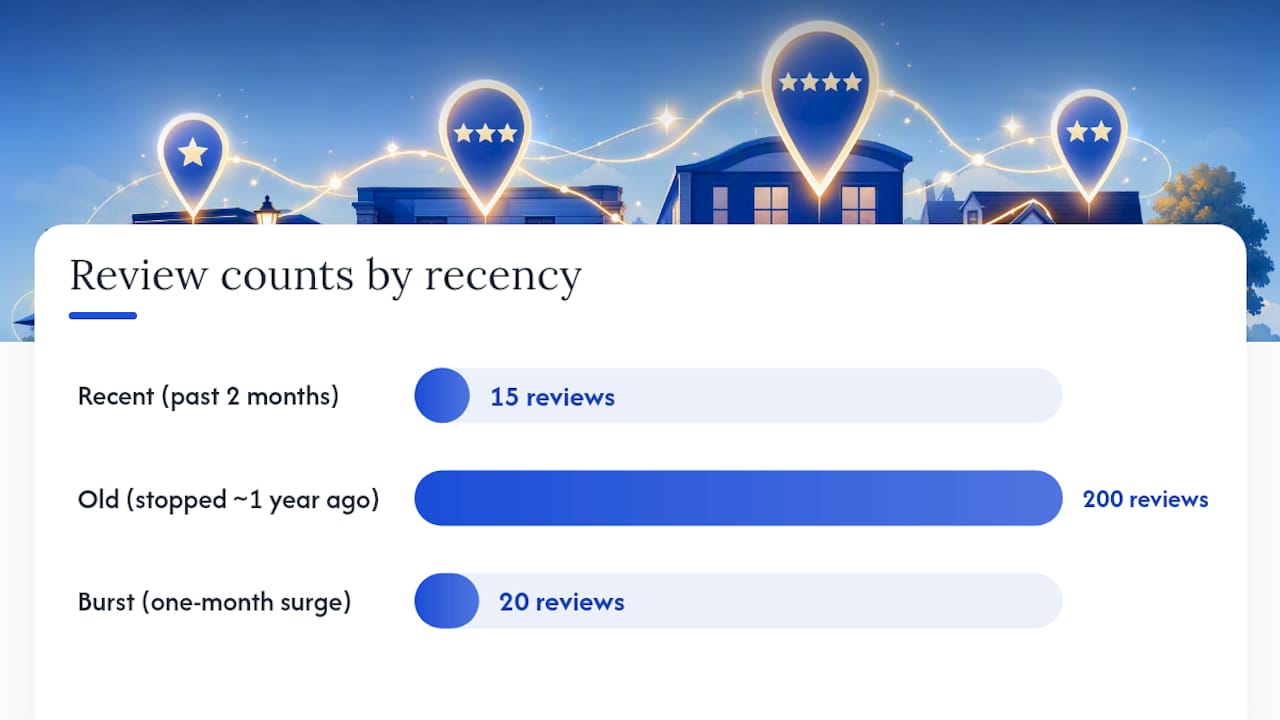
Review count matters less than most owners think. Review velocity, meaning a steady stream of recent reviews, correlates more strongly with local ranking movement than a large stockpile of old ones. A business with 15 reviews from the past two months often outperforms one with 200 reviews that stopped coming in a year ago.
Here's a simple script framework you can adapt for three channels:
- In person: "We'd really appreciate it if you left us a quick review. Here's a QR code that takes you right to the page." Hand them a card or show them your phone.
- Email: Send within 24 hours of service completion. Keep it under three sentences and include a direct link to your GBP review page.
- SMS: "Thanks for choosing us today! If you have 60 seconds, we'd love a review: [link]." Send same day while the experience is fresh.
Aim for a steady cadence rather than a burst. Two to four new reviews a week beats twenty in one month followed by silence. Respond promptly to positive reviews with a specific, personal thank you. Respond promptly to negative reviews, acknowledge the issue without getting defensive, and offer to resolve it offline. Escalate to a phone call or direct message if the reviewer seems genuinely upset rather than trying to argue in public comments.
Pro Tip: Never offer a discount or refund in exchange for a review, positive or negative. It violates Google's policies and can get reviews removed or your profile flagged.
What Local Content Actually Attracts Nearby Customers?
Generic blog posts rarely move local rankings. Content built around local intent does. That means service pages tied to specific offerings, neighborhood pages tied to specific areas you serve, local FAQ pages answering questions your actual customers ask, and event pages if you sponsor or attend community happenings.
Local keyword research doesn't require expensive tools to start. Type your service plus your city into Google and study the autocomplete suggestions and the "People also ask" box. Those phrases reflect real search behavior. Voice search adds another layer: people speaking to a phone or smart speaker tend to phrase queries conversationally, like "where can I get my roof fixed near me tonight" rather than typing "roof repair [city]." Structuring FAQ content around natural questions helps you show up in both traditional and voice results.
To make each location page genuinely unique rather than a copy-paste template:
- Mention specific neighborhoods, landmarks, or streets within that service area.
- Include a photo taken at that location, not a stock image.
- Reference local events, weather patterns, or regional quirks relevant to your service.
- Link internally between related location and service pages to help both customers and search engines navigate your site.
Service-area businesses without a public storefront can still rank well this way, since proper configuration and verification matter more than a physical address for many local categories.
Where Can Small Businesses Find Local Backlinks?
Local backlinks tell Google your business is a real, connected part of your community, and they don't require an expensive PR firm to earn.
Realistic opportunities include joining your local chamber of commerce (most offer a member directory link), pitching a short story to a local news outlet about something newsworthy you're doing, sponsoring a youth sports team or community event for a listing on their site, and asking suppliers or partners to add a testimonial page that links back to you.
The tactics that scale best over time are relationship-based: attend local business mixers, co-host a small event with a complementary business, or offer your expertise as a quoted source when local journalists write about your industry. A single link from your regional newspaper carries more weight than ten links from unrelated national directories.
For quality standards, prioritize links from sites with real local relevance and real traffic over quantity. A realistic annual target for a small business is 10 to 20 genuinely local, relevant links, earned steadily rather than all at once. Building local content and community relationships makes this a natural byproduct rather than a separate outreach grind.
How Do You Track Local SEO Progress Correctly?
You need three categories of data, and none of them require expensive software to start.
Track Map Pack visibility using geo-grid rank tracking, which shows how you rank from multiple points around your service area rather than just one search location. A structured local SEO audit treats this kind of monitoring as essential, since your rank can vary significantly depending on where the searcher is standing.
Beyond rank position, watch your GBP Insights dashboard for calls, direction requests, and website clicks generated directly from your profile. Pair that with Google Search Console for organic clicks, impressions, and which local queries are actually driving traffic to your site.
- Map Pack position (geo-grid, weekly).
- GBP calls, direction requests, website clicks (GBP Insights, weekly).
- Organic clicks and impressions for local queries (Search Console, weekly).
- Conversion actions: form fills, calls, or bookings tracked back to source.
Expect GBP-driven improvements within two to four weeks of major profile fixes, since industry guidance suggests profile and review changes move faster than organic site changes, which can take two to three months to fully register.
How Does a Web Studio Handle the Technical Side of Local SEO?
The GBP and review work above is well within reach for most owners. The technical layer is where things get harder to DIY correctly, and it's the part a small studio typically handles for clients.
Concrete technical implementation includes:
- LocalBusiness JSON-LD placed in the site's header code, populated with your exact NAP, hours, and category, matching your GBP data exactly.
- Hosting configured for fast load times, since page speed affects both user experience and how search engines evaluate your site.
- FAQPage schema added to pages likely to answer common customer questions.
- Ongoing maintenance to keep NAP data, hours, and service listings synced across the website and GBP as your business changes.
Nordicweb builds this technical foundation into every custom site from the start, rather than treating SEO setup as an afterthought bolted on later. That matters because schema and site speed issues are notoriously easy to get wrong on template-based builders, where you're often locked into whatever structure the platform gives you.
What Should You Prioritize First for the Fastest Results?
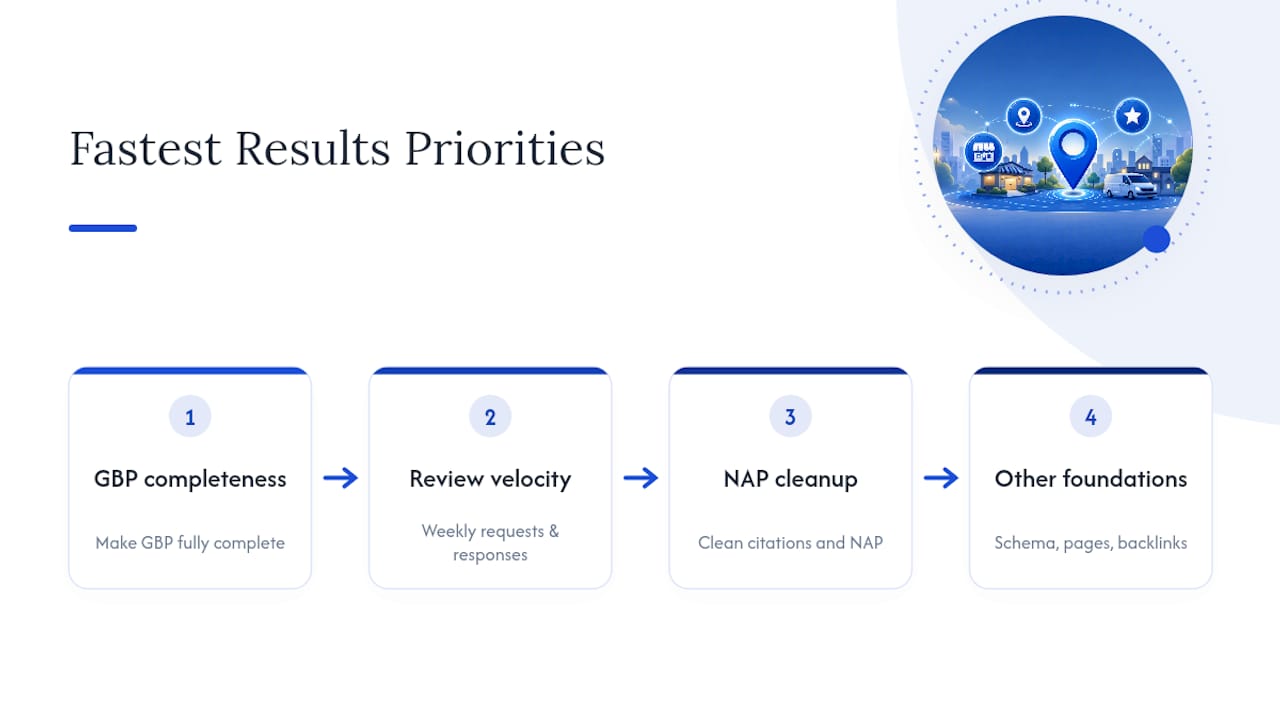
If you only have a few hours a week, the sequence that produces results fastest is GBP completeness first, review velocity second, and NAP cleanup third. Everything else, from schema to location pages to backlinks, compounds on top of those three foundations rather than replacing them.
Split your time roughly this way: weekly tasks should be review requests, GBP posts, and review responses, no more than an hour combined. Monthly tasks should be citation audits, rank tracking review, and content updates. Delegate the technical build (schema, location pages, site speed) once, rather than trying to relearn it every quarter.
The most common trap is chasing backlinks or blog content before GBP and reviews are solid. That's building a second floor before the foundation cures. Fix the foundation first, and the rest gets noticeably easier.
— Maksymilian Slusarczyk
When Does It Make Sense to Bring in Nordicweb?
Everything above is doable yourself with a few hours a week, and most small business owners can handle GBP setup, review requests, and basic citation cleanup solo. Where it gets expensive isn't the time. It's the mistakes: a broken schema tag, a slow host, or a location page built on a template that can't be customized properly. That's where Nordicweb earns its keep.
A web studio can build custom websites and webshops with technical SEO setup included from day one, not bolted on after launch. That means correctly structured LocalBusiness schema, hosting configured for speed, and ongoing maintenance so your NAP data stays accurate as your business changes. Pricing is upfront and transparent, with no hidden fees buried in a contract.
If your website is the piece holding your local visibility back, or you're tired of guessing what a redesign will actually cost, visit Nordicweb and request a quote. It's a straightforward next step toward a site built to support everything else in this checklist.