Most small businesses should budget between $1,500 and $7,000 for a professional website in 2026, with $2,500 to $5,000 hitting the sweet spot for a lead-generating site done right. DIY builds run $0 to $1,500 (per ProjectCostEstimator's dataset, drawn from over 600 quotes, and platforms like WordPress), agencies and custom builds start around $8,000 and climb well past $50,000. Nordicweb builds sites across every one of these bands with the price locked in before work starts.
TL;DR:
- A small business website in 2026 typically costs between $1,500 and $7,000 for professional builds, with DIY options starting at $0.
- The overall price depends heavily on scope, platform choice, regional location, and whether the project is a landing page, brochure site, or complex web app.
- Design accounts for roughly 30% to 45% of the total cost, with development, integrations, and features significantly influencing the final quote.
- Ongoing costs vary from about $15 to $300 per month depending on platform and hosting requirements, with maintenance fees often overlooked.
- To get an accurate quote, provide a detailed brief, specify your budget upfront, and request line-item breakdowns from multiple vendors.
Table of Contents
- How Much Does A Website Cost? 2026 Price Ranges By Provider Type
- What Actually Makes Up Your Website Design Cost Breakdown
- Website Cost By Project Type: Landing Pages To Custom Web Apps
- Why Do Website Quotes Vary So Much?
- What Should You Budget For Ongoing Website Costs?
- How Do You Get An Accurate Website Quote?
- How Nordicweb's Pricing Maps To These Budgets
- What's The One Number Small Business Owners Should Actually Budget?
- Get A Transparent Quote For Your Website Or Webshop
- Sources
How Much Does A Website Cost? 2026 Price Ranges By Provider Type
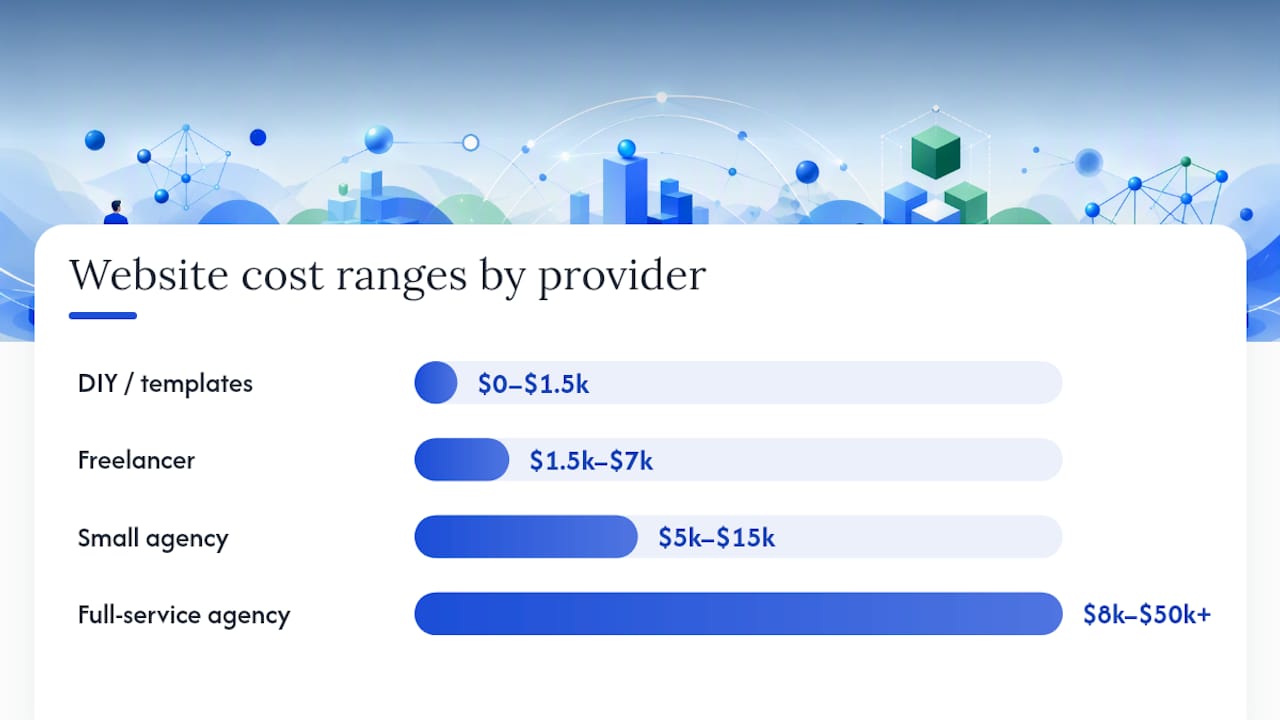
The gap between a DIY site and an agency build isn't just about polish. It's about who's doing the work, how much hand-holding you get, and what happens after launch. Here's how the market breaks down right now.
- DIY/template builds: $0 to $1,500. You're doing the work yourself on a builder or theme, paying mostly for hosting and maybe a premium template.
- Freelancers: $1,500 to $7,000 for most small-business projects. You get a real designer or developer, but usually one person wearing every hat.
- Small agencies: $5,000 to $15,000. More hands on the project, project management, and usually a testing phase before launch.
- Full-service/custom agencies: $8,000 to $50,000+. Custom code, integrations, brand strategy, and ongoing support built into the relationship.
Those bands hold up against Forbes Advisor's 2026 research, which puts professional work "starting around $1,500" and DIY builds as low as $0 once you're paying only for a domain and a builder subscription.
Running costs follow the same logic, and they vary a lot by platform. A basic WordPress site might run $15 to $40 a month between hosting and plugin licenses. A Shopify store typically lands between $30 and $150 a month once you add apps for shipping, reviews, and email marketing. WooCommerce sits in between, and a custom-built site can run anywhere depending on the hosting environment and how many third-party services it leans on.
One thing that catches people off guard: identical project scope can cost wildly different amounts depending on who builds it and where they're based. ProjectCostEstimator's 2026 data found regional multipliers ranging from 0.30x in South and Southeast Asia to 1.28x in the United States, a spread of more than four times for the exact same deliverable. That's worth knowing before you assume a low quote means low quality, or a high quote means you're getting ripped off.
What Actually Makes Up Your Website Design Cost Breakdown
A website quote isn't one number. It's a stack of line items, and understanding what each one covers helps you spot where a vendor is padding the bill and where they're genuinely doing work that costs money.
Design and development together eat most of a project budget, but they're not split evenly, and the split tells you something. According to ProjectCostEstimator's pricing research, design typically represents 30% to 45% of total website cost. That covers wireframes, mockups, brand application, and user experience decisions. The rest goes to development: the actual coding, CMS setup, and integration work that turns a design file into a working site.
Pro Tip: If a quote lists "design" as a tiny fraction of the total, ask what's driving the rest of the cost. Sometimes it's legitimate backend complexity. Sometimes it's a sign the vendor is reusing a template and charging development rates for configuration work.
Here's roughly what each line item runs in 2026:
- Domain registration: $10 to $20 a year.
- Hosting: $10 to $50 a month for small sites, more for ecommerce with traffic.
- SSL certificate: Often bundled free with hosting; standalone certificates run $0 to $100 a year.
- CMS setup (WordPress, etc.): $200 to $1,500 depending on customization.
- Design mockups: $500 to $5,000+ depending on page count and complexity.
- Front-end and back-end development: $1,000 to $20,000+, the widest range of any line item.
- Content and copywriting: $50 to $500 per page.
- Custom photography or imagery: $200 to $2,000 for a shoot or licensed image set.
- Integrations (payment, CRM, email): $200 to $3,000+ per integration.
- Testing and QA: Often 10% to 15% of the development budget, sometimes folded in silently.
Add-on features are where budgets balloon. Custom ecommerce checkout flows, API integrations with inventory or accounting software, and advanced animation work can each add thousands to a quote that started out looking modest. If a vendor's initial estimate seems low, ask specifically whether these features are included or billed separately.
Website Cost By Project Type: Landing Pages To Custom Web Apps
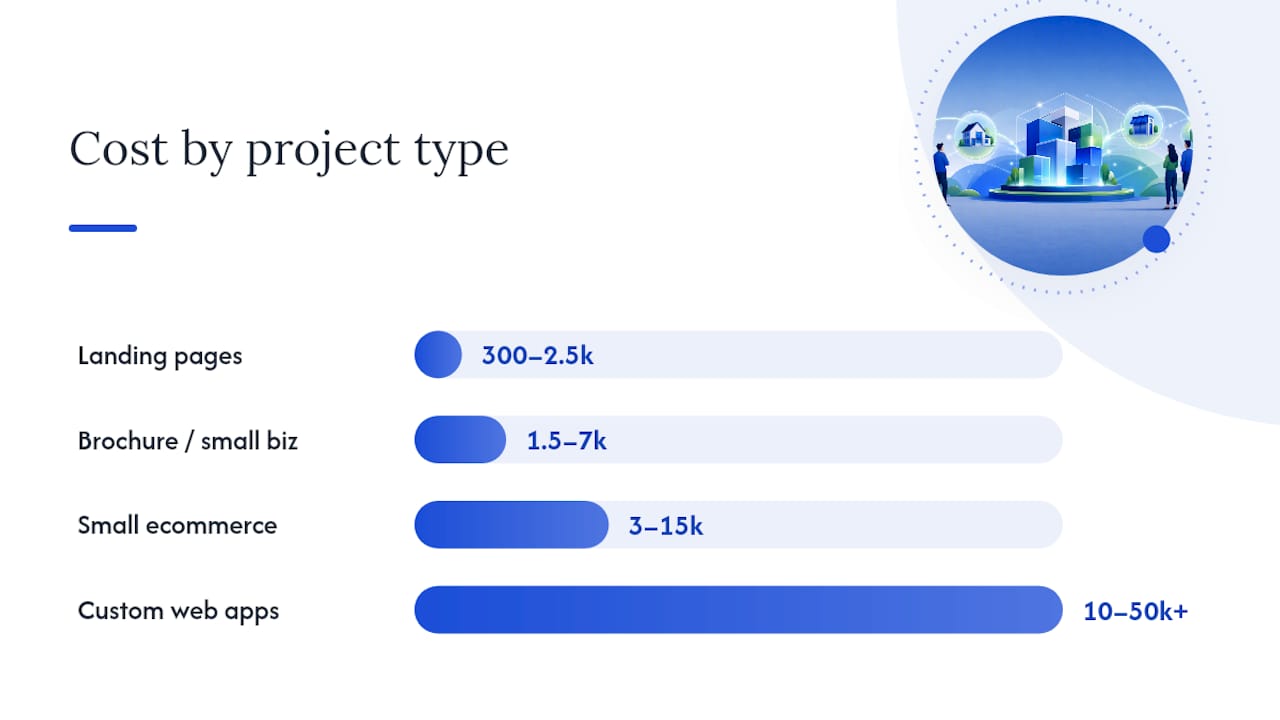
The single biggest factor in your quote is what you're actually building. A one-page landing site and a marketplace with user accounts are not the same category of project, even though both are technically "a website."
Landing pages run $300 to $2,500. You're usually looking at a single page with a hero section, a value proposition, and one clear call to action. Freelancers often deliver these in one to two weeks; agencies may take three to four weeks once you factor in copywriting and revisions.
Brochure or small business sites (5 to 10 pages, a contact form, maybe a blog) run $1,500 to $7,000 with freelancers and $5,000 to $15,000 with agencies. A sample $4,000 budget typically includes: five to seven pages, basic on-page SEO, a CMS so you can edit content yourself, mobile optimization, and one round of revisions. Timeline: three to six weeks.
Small ecommerce stores run $3,000 to $15,000 depending on catalog size and whether you need custom checkout logic. A $6,000 to $8,000 build usually covers a Shopify or WooCommerce setup, payment gateway integration, product upload for a modest catalog, and basic email marketing hookup. Expect four to eight weeks, longer if product photography isn't ready when development starts.
Custom web apps and marketplaces with user accounts, booking systems, or multivendor logic start around $10,000 and can run past $50,000 for anything with real complexity. ProjectCostEstimator's 2026 dataset confirms this is where the widest range in the entire market lives, because scope varies so much project to project. Timelines stretch from two to six months.
A useful way to think about your sample budget: at $2,500, you're getting a competent brochure site with basic SEO and no frills. At $5,000, you're adding a proper CMS, better design polish, and likely one integration like a booking widget or newsletter signup. At $10,000 and up, you're paying for custom functionality, project management, and usually a warranty period after launch.
Why Do Website Quotes Vary So Much?
Four things drive most of the difference between a $2,000 quote and a $20,000 quote for what sounds like the same project on paper.
Scope is the most controllable lever. Every extra page, every added feature, every third-party integration adds cost, and it's rarely linear. A five-page site with no integrations might cost $2,000. Add a booking calendar and a live chat widget, and you can easily double that, because each integration requires setup, testing, and often ongoing licensing.
Platform choice carries its own multiplier. ProjectCostEstimator's data shows Shopify builds running about 0.85x the cost of an equivalent custom-coded site, while fully custom code runs about 1.61x. Shopify and WordPress both trade some flexibility for lower upfront cost and a bigger plugin ecosystem, while custom code costs more but gives you full control.
Regional multipliers explain a lot of quote spread that people wrongly attribute to skill or quality. As noted above, the same scope of work can swing from 0.30x to 1.28x depending on where the provider is based.
Agency versus freelancer is the fourth lever, and it's a real premium, not just perception. Agencies typically charge 2.4 to 2.7 times freelancer medians for the same project type, according to ProjectCostEstimator's data. Part of that premium pays for project management and a team instead of a single point of failure, which Clutch's pricing research notes is worth weighing against whether you actually need that layer of support.
Pro Tip: Before you chase the cheapest quote, decide whether you're optimizing for design polish or for search visibility and load speed. A gorgeous, animation-heavy site that loads slowly will lose more customers than a plainer one that ranks and loads fast. Put your budget where it moves the needle for your specific business.
What Should You Budget For Ongoing Website Costs?
The build is a one-time cost. Everything after launch is recurring, and it's the part small business owners most often forget to plan for.
A basic WordPress site typically runs $15 to $40 a month on the low end for hosting and essential plugins, climbing to $100 or more a month if you're running premium plugins, a page builder license, and managed hosting. Shopify stores usually land between $30 and $150 a month once you count the platform fee and a handful of apps. Custom-built or Magento-style sites tend to run highest, often $100 to $300+ a month, because they need more specialized hosting and maintenance attention.
On a $5,000 site, that's $750 to $1,000 annually for security patches, plugin updates, backups, and small content changes. Skip this and you're gambling on the site staying secure and functional without anyone watching it.
Forbes Advisor's 2026 research puts typical maintenance in the $20 to $100+ per year range for the bare minimum, though that figure assumes a very simple site with no active development or content updates happening.
The costs that blindside people usually aren't the big ones. Audit your monthly software subscriptions every few months. It's the easiest way to catch creeping costs before they add up to a real problem.
How Do You Get An Accurate Website Quote?
A vague brief gets you vague, incomparable quotes. Here's how to request pricing you can actually compare across vendors.
- Write a one-page brief covering your business goals, the exact pages or features you need, any integrations (payment, booking, CRM), your timeline, and any hosting preference you already have.
- State your budget range up front. Vendors design differently for $2,000 than for $10,000, and hiding your number just wastes everyone's time on mismatched proposals.
- Ask who owns the code and content after launch. Some vendors retain ownership or lock you into their hosting. Get this in writing before you sign.
- Ask what handover deliverables look like. You want source files, admin access, and documentation, not just a live URL.
- Ask about backups, maintenance, and support after launch. Is there a warranty period? What happens if something breaks in month two?
- Request three quotes minimum, and build a simple comparison table with rows for total cost, timeline, pages included, integrations included, and what's billed separately.
Watch for a few red flags: a quote with no breakdown by line item, a price that seems far below every other bid with no explanation, and vague language around "ongoing support" with no specifics on what that support actually includes. A survey on website construction costs found that roughly $1,000 sits in a gray zone, workable for simple template projects but usually not enough for custom design or real SEO work, which is exactly why getting multiple detailed quotes matters at that budget level.
How Nordicweb's Pricing Maps To These Budgets
Nordicweb builds across the ranges outlined above, and every quote is fixed before work begins, no surprise invoices halfway through a project. That single detail addresses the biggest complaint small business owners have about hiring help online: not knowing what the final bill will be.
Our services cover the full spectrum small businesses actually need:
- Custom website and webshop design and development, from simple one-page sites to fully tailored stores with bespoke payment and order management systems.
- Technical SEO setup baked into every build so the site is discoverable on search engines from launch, not bolted on afterward.
- Reliable hosting and ongoing maintenance, so you're not left managing plugin updates and security patches yourself.
- Optional marketing and ad management across Google, Meta, and Instagram once your site is live and you're ready to drive traffic.
Whether you're closer to the $2,500 lead-generation band or the $15,000-plus custom webshop territory, the pricing structure works the same way: you see the number before you commit, and it doesn't move.
What's The One Number Small Business Owners Should Actually Budget?
If you're a small business owner with no ecommerce ambitions yet, budget $2,500 to $5,000 for your first real site and stop there. That band buys enough design quality and SEO groundwork to generate leads without paying for agency overhead you don't need yet.
Choose DIY only if your business genuinely can't spend anything right now. Choose a freelancer once you have a real budget and a clear brief. Choose an agency only when you need multiple integrations, ecommerce complexity, or ongoing marketing support beyond the build itself.
— Max
Get A Transparent Quote For Your Website Or Webshop
Nordicweb removes the guessing game from every quote we send. If you've read through the price bands above and you're still not sure where your project lands, that's normal, most quotes in this industry are vague on purpose. We build custom websites and webshops with the full cost, including hosting, maintenance, and technical SEO, laid out before you sign anything.
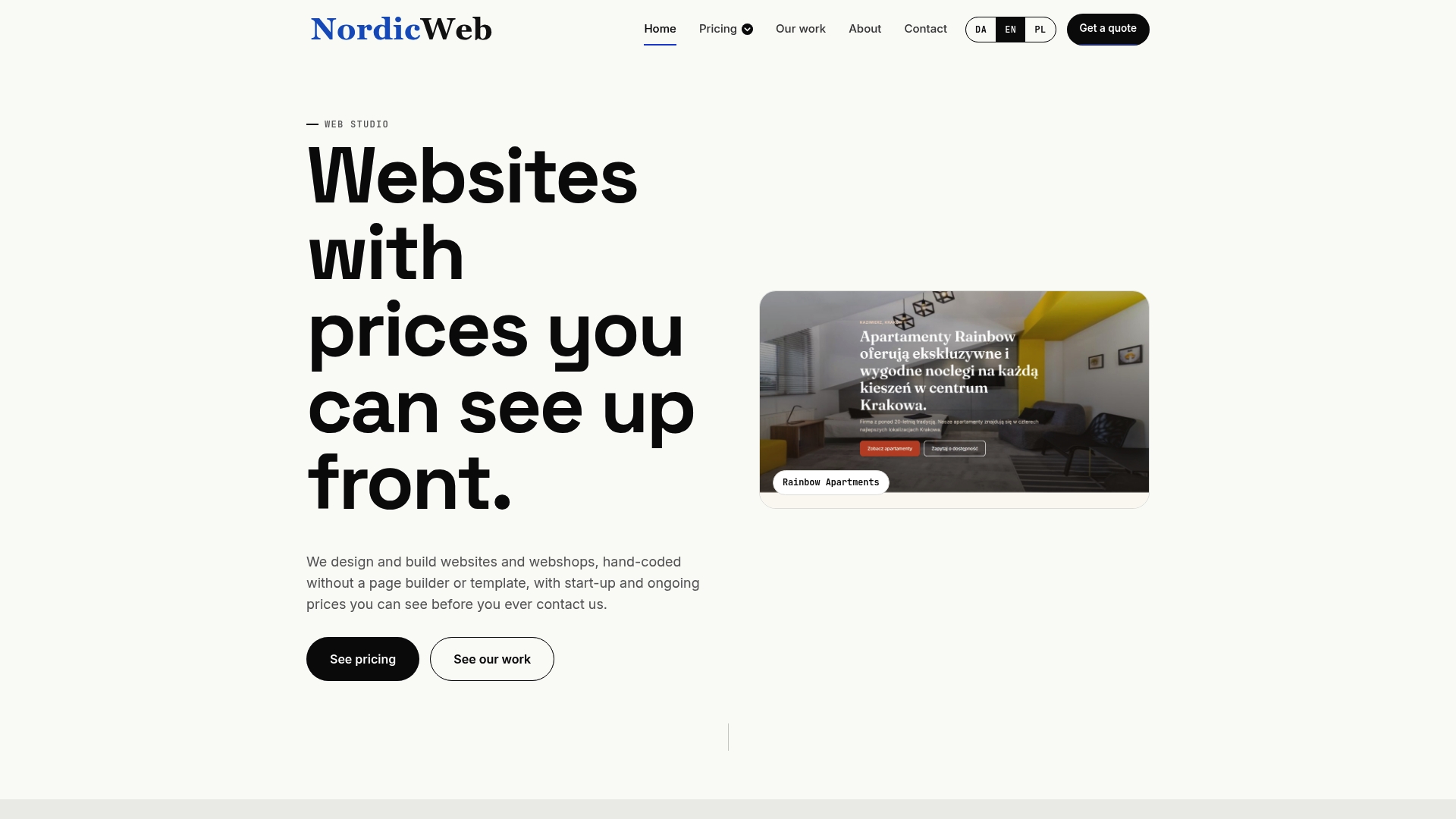
Whether you're budgeting for a simple business site in the $2,500 to $5,000 range or a full webshop with payment and order management built in, our team scopes the project against your actual goals, not a generic package. You get a fixed number, a clear list of what's included, and ongoing support once the site is live. Visit Nordicweb to describe your project and get a quote with no hidden line items waiting to surface later.
Sources
The price bands and regional multipliers in this article draw primarily from ProjectCostEstimator's 2026 website cost report, calibrated against more than 600 project quotes, along with Clutch's web design pricing data and Forbes Advisor's 2026 cost guide. Platform cost references come from Wordpress.